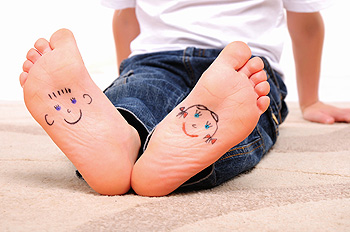
It is never normal for a child to experience pain in his or her feet. Foot pain that lasts more than a few days and limits a child’s ability to walk should be examined by a podiatrist. Many adult foot ailments originate in childhood and may be present at birth. Common foot issues that are experienced by children are pediatric flat foot, Sever’s disease, ingrown toenails, and plantar warts.
A child’s foot grows rapidly during the first year. Consequently, foot specialists consider the first year to be the most crucial point in the foot development process. There are ways you can help ensure that your child’s feet develop properly. One way is to carefully look at your baby’s feet. If you notice any deformities, you should immediately seek professional care. You should also loosely cover your child’s foot, since tight coverings may prevent movement and inhibit normal development. Another tip is to change the baby’s positioning throughout the day. If your baby lies down in one spot for too long, it may put an excessive amount of strain on the feet and legs.
It is best that you try not to force a child to start walking. Children will begin to walk when they are both physically and emotionally capable to do so. You should also avoid comparing your child’s walking progress with other children because the age range for independent walking varies. When your child’s feet begin to develop, you may need to change both their shoe and sock size every few months to allow room for their feet to grow.
Kids are sometimes prone to splinters, cuts, and severe injuries because they tend to walk around barefoot. This also makes them more susceptible to developing plantar warts, a condition caused by a virus that invades the sole of the foot through breaks in the skin. These ailments can be avoided by making sure your child wears shoes in unsanitary environments. You should also wash any minor cuts or scrapes on your child’s feet.
Kids are also prone to developing Sever’s disease, which is the inflammation of the growth plate in the heel. Typically the result of overuse, Sever’s disease often develops inactive children who are experiencing a growth spurt. When a child experiences a growth spurt, the heel bone will often grow faster than the other muscles, tendons, and ligaments in his or her lower extremities. This causes Sever’s disease.
As a parent, you should ensure that your child’s feet are developing properly and are being properly maintained. Consequently, it is important that you perform routine inspections on his or her feet to detect any injuries or deformities in their early stages. Early detection and treatment will help to ensure that your child does not develop any serious foot conditions.
Pediatric Foot Problems
Dr. Anavian has extensive experience and training in the care of children’s foot problems. During his residency, Dr. Anavian was the Chief Resident for the Baja Project for Crippled Children and was responsible for running the Baja Projects clinics in Tijuana and Mexicali, Mexico. He received extensive training in pediatric surgery of the foot and ankle as well as conservative care of pediatric deformities and pathology. Since his residency he has become one of the Co-directors of the Baja Project for Crippled Children.
Our office has extensive experience in treating problems that children have with their feet. Whether your child was born with foot problems or has developed problems due to sports or dance, our office can help your child stay active and keep them participating in the activities they love. We treat many children and teenagers who are having trouble doing sports or dance because of problems with their feet. We have many dancers and ballerinas who have benefited from treatment. If your child is having problems doing the activities they like to do, please call for a consultation. Foot pain is never normal.
Dr. Anavian can help your child with the following problems:
- Dance injuries or pain (Ballet, Hip Hop, Jazz, Modern dance).
- Sports injuries or pain (Soccer, Basketball, Baseball, Football, etc.).
- Flat feet, High Arch feet.
- Child does not want to run or be active.
- In or Out toeing.
- Skin Conditions (Athletes foot, Warts, etc.).
- Nail problems.
